
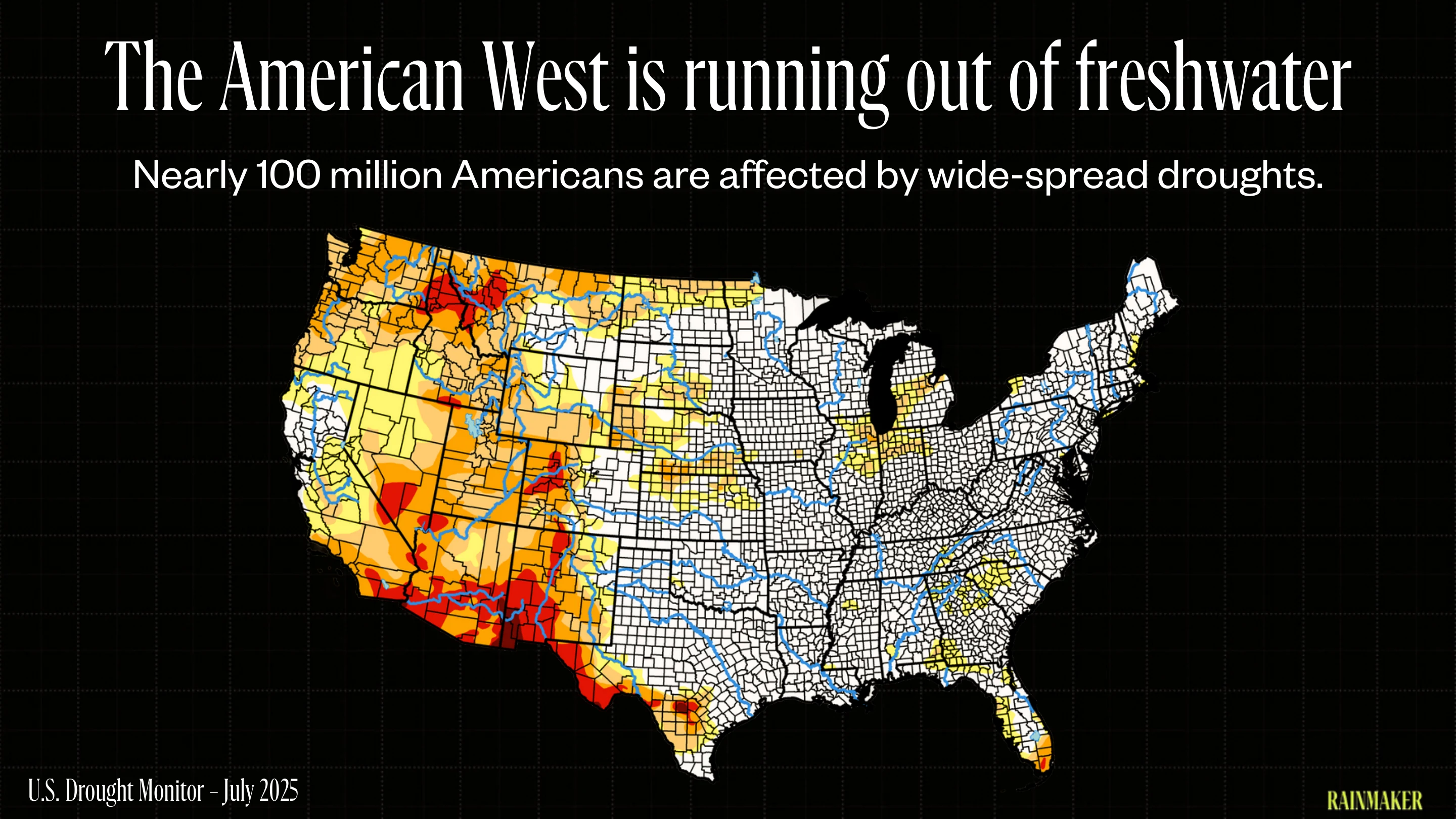
The American West is running out of water. Its farms, its aquifers, its power grids, and now its data centers all draw on rivers and snowpack that no longer keep up. The Great Salt Lake, fed first and most by the Bear River, has been receding for decades. Everyone called it a tragedy. Almost no one treated it as an engineering problem.
The strange part is that the water is often already overhead. Most of the moisture that crosses a mountain range in a storm never falls. Cloud seeding gives those clouds the one thing they are missing, a speck for water to freeze onto, so snow that would have drifted away lands on the peaks instead. Done well, it is the cheapest new water in the West.
For seventy years the practice worked but could not be proven, so it was argued about instead of scaled. Rainmaker changed the terms. This winter it flew the largest cloud seeding program in modern American history across 7,500 square miles of the Bear River Basin, hired by two states, watched by independent scientists, and counted in acre-feet. Target. Seed. Validate.
We went to Utah to meet the people doing it. What we found was a crew: engineers who build aircraft that fly into icing clouds on purpose, operators who drive sixteen hours to stand under a rain cloud they intend to open, forecasters who treat the sky as a supply chain.
The dream sold to most of this generation is to work from anywhere and touch nothing. This is the opposite bet: that the most alive people of this generation want work that leaves a mark on the physical world. Work you can drink.
Don’t work remote. Do real work.